What will it take to fix a European Union troubled by heavy debts and internal friction? The story of the U.S., which celebrates its 235th year of independence on July 4, offers a parable that Europe’s leaders might find instructive.
In the late 18th century, financial troubles threatened to tear apart the newly formed union. In many ways, the crisis was not unlike the one Europe is now trying to contain with a second bailout of Greece.
After the Revolutionary War, the huge debts of states such as Massachusetts and South Carolina were strangling an already depressed economy. A farmers’ rebellion against rising taxes brought the young nation to the brink of its first civil war. Faith in U.S. credit fell so low that veterans were selling government IOUs for as little as 15 cents on the dollar.
Much like today’s Europe, the U.S. lacked a federal executive branch with the power to manage the crisis. But its first Treasury secretary, Alexander Hamilton, had a proposal that went far beyond what anyone in Europe is now considering. His plan: Have Congress authorize the federal government to take responsibility for some $25 million in states’ debts -- the equivalent of about $2 trillion in today’s economy -- and to raise the money to pay them.
The plan had some flaws, and Hamilton was fully aware of them, according to biographer Ron Chernow. The government would be rewarding speculators who had bought the debt at a discount, and fiscally strong states would effectively be bailing out weak ones.
Fire the Fed, Let OPEC Run U.S. Economic Policy: Caroline Baum
The running commentary on the U.S. economy can be reduced to two main themes. The first is that monetary and fiscal policies have run out of bullets. The second is that oil prices are responsible for our current malaise.
If that’s the case -- if the Federal Reserve is impotent, the federal government is broke and oil prices are responsible for the economy’s ebbs and flows -- why not put OPEC in charge of economic policy?
Seriously, if you believe that soaring oil prices, which are cutting into household budgets and sapping consumer spending, are the main problem, why risk the unintended consequences of zero percent interest rates -- for an extended period -- when the Organization of Petroleum Exporting Countries could achieve the same kind of stimulus by opening the pump jacks?
You’re probably thinking, she’s kidding, right? Yes, I am. Influencing the demand for goods and services by manipulating the overnight interbank rate (the Fed’s bailiwick) isn’t the same thing as managing the supply, and the price, of oil. However, a reasonable person reading the analysis of why the U.S. economy is where it is today might be tempted to conclude the two are interchangeable.
Clearly President Barack Obama is sympathetic to the view that oil makes the world go round (and may impede his re- election). Last week, the president announced the release of 30 million barrels of oil from the nation’s Strategic Petroleum Reserve, a storehouse designed for use in the event of true emergencies.
Main Article Well, that was fast. It only took nearly 4 months for Wall Street's best analysts to determine that Fukushima was not bullish for the global economy after all. Actually, that statement is incorrect. They still think it is bullish - especially Joe LaVorgna, who's permabullish attitude has sealed his future as the worst economist on Wall Street.
Today we learn that because of the triple disaster in Japan in March, Tokyo residents and factories will need to consume 15% less energy because that's the amount that is missing from the grid. In turn, the cost of electricity has jumped. As a permabull Wall Street analysts, this must be bullish.
More bull... ish news is arriving as we speak. Japan's economic sentiment index just tanked (along with Toyota's, Panasonic's, Fuji Heavy Industry's, et al's profits) at the fastest rate since 2009. Don't worry your little Wii remote wielding fingers - there's always tomorrow. And next year.
As Portugal likes to say, our bonds will be better some day. Speaking of which, Portugal has now followed exactly in the same steps as Greece. In other words, it went from insolvent to, insolvent and enslavement. Ten year is yielding a comical 11.61%.
Need more bullish news? How about radioactive emails that leaked from England that show the British gov’t worked with nuke companies on PR campaign to downplay Fukushima. As Energy News says, the degree of collusion "is truly shocking.” Somehow, we're not surprised.
Since we have no inflation in this country or anywhere else around the world where people eat and drive cars, no need to worry about the bullish drought in Georgia, which is now spreading to peach farms. How's that price working out for your peaches?
While all of the MSM outlets claim the ISM report is bullish, we present to you the only piece of information that matters - the New Orders Minus Inventory which shows clearly, the economy is slowing down. Somehow, Wall Street economists overlook that little detail and jump right to the composite index which signifies the growth came from growing inventories.
Speaking of inventories, GM is doing a fine job at stuffing dealer lots with an all time high amount of 605,000 vehicles. Of course, they are simply waiting for the super bullish second half of the year which Justin Bieber has confirmed and promised is coming. That should help to push depreciating and rusting GM vehicles off these grass filled lots in record time. Only one year's worth. He apologizes that the past 8 halves were not bullish as he said it would be. There's always another half, and that one will be bullish.
Equity futures are creeping higher again this morning as we launch into a new quarter and new month. The dollar is higher, bonds are higher, oil is lower, gold & silver are making sizable corrections lower, and most food commodities are sharply lower as well.
Confused over the possibility of a significant decline in Quantitative Easing, all whilst massive money printing is still ongoing, the dollar has etched out a triangle as has the schizoid Euro. Below are daily charts of the dollar on the left and euro on the right. The euro ran into resistance at the same time the dollar hit support within that triangle, and thus for the equity trend to continue we need the currencies to bust out of, and run, from those triangles:
Of course “injecting” another $124 Billion into Greece will work out peachy, just like the last iteration of print money from nothing, take real assets and productive people’s efforts, robbery. I’d say that it will work out the same as last time, but that’s not the way debt works, it will work out worse than last time because the effects are cumulative, just like the nuclear hot particles we are all consuming.
Speaking of hot particles, if you haven’t heard Arnie Gunderson’s latest interview yet, you should. It’s an hour long, but worth it: Arnie Gunderson Interview
Motor Vehicle Sales are reported throughout the day today, “Consumer” Sentiment, Construction Spending, and the Manufacturing ISM will all be released at 10 Eastern this morning. Of course we’ll report on these inside of today’s daily thread.
M2 money supply was reported yesterday as gaining $30 Billion in the week, this is up tremendously from the previous week’s $11.7 billion (which is still a ton).
Looking at the money supply charts, the St. Louis “Fed” is actually doing a better job of breaking out the component money supply parts. They are also finally including explanations about how they calculate each chart. I noticed that they broke out Small Time Deposits and that when they do, it produces an M2 Minus chart that clearly shows the parabola nature of the “Fed’s” Ponzi debt backed money:
All parabolas eventually collapse, this one will be no different.
According to the “Fed,” “The small-denomination time deposits component of M2 includes time deposits at banks and thrifts with balances less than $100,000.” That would be pretty much everyone in the middle-class and lower, right? So, let’s take a look at just the Small Time Deposits component of M2:
Straight up, then straight down. Note that the straight down part is still ongoing. I think that says a ton about the winners and the losers of “Quantitative Easing,” and about corporate capture of government in general. Ehhh, be quite, swallow a few more hot particles, and get back to “producing,” whatever that means in America these days (I think it’s going to mean taking care of a lot of cancer patients about a decade from now).
Just as a refresher, here’s the current Base Money chart:
And here’s the hot money effect on the M1 Multiplier which is setting new lows:
This latest rally is one to be careful of in my opinion. The market is already very overbought with the major indices all now above their 50dma’s, but also well above their upper Bollinger Bands. Of course the difference between now and just a week ago is nothing but more debt for Greece, and I can thus guarantee that we’ll be revisiting the debt issues again shortly, as in very shortly. Note that the time intervals between debt driven events are growing shorter and shorter, the result of exponential impossible math.
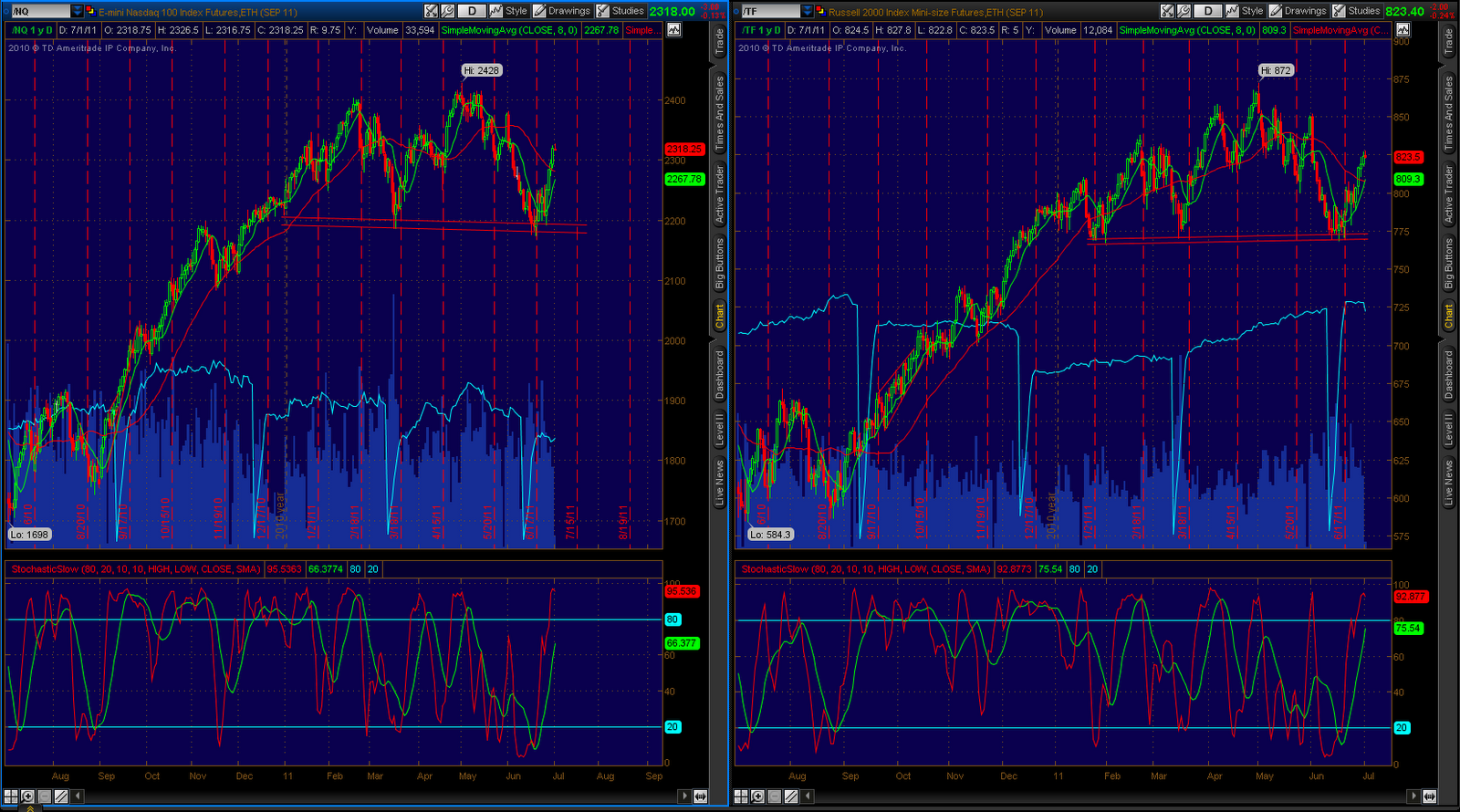
Below is a daily chart of the NDX on the left and Russell 2000 on the right. Both have formed pretty clear Head & Shoulder’s patterns, the right shoulder is now formed and thus I would not be surprised by a turn back down to the neckline soon. Of course exceeding the top of the Head would nullify this pattern, but there it is:
LONDON/BEIJING, July 1 (Reuters) - The global manufacturing sector, a key driver of economic growth, lost steam for a second month running as monetary policy tightening began to bite, surveys showed on Friday.
Purchasing managers' indexes in Asia and Europe slid to multi-month lows in June as factories fought a twin battle with weaker consumer demand overseas and tightening monetary policy at home.
Central banks have been unwinding ultra-loose monetary policy and hiking interest rates aggressively in Asia as they turn their attention to inflation, hampering growth in the process.
The European Central Bank is expected to raise rates next week, having done so in April, and the U.S. Federal Reserve ended its $600 billion bond-buying stimulus programme this week and has yet to offer any hints of more monetary easing to come.
US Stock Futures Slightly Higher As Euro, China Manufacturing Slow
U.S. stock market futures were slightly higher Friday, with investors eyeing data that showed a slowdown in manufacturing for both Europe and China and looked ahead to a key U.S. manufacturing gauge to be released later.
Futures for the Dow Jones Industrial Average rose 27 points to 12372, while those for the Standard & Poor's 500 was up 1 point at 1316.50. Those for the Nasdaq 100 index rose 4 points to 2325.
The Dow tallied a fourth-consecutive day of gains on Thursday, adding 1.3%, inspired by better-than-expected economic data and after Greece's austerity measures passed a key parliamentary hurdle.
Thursday's Chicago PMI data inspired some optimism ahead of an important indicator--the Institute for Supply Management's June manufacturing index, due at 10 a.m., EDT. A survey of analysts polled by MarketWatch are expecting the index to slip to 52% from a prior 53.5%.